

These gingerbread crinkle cookies are soft, chewy molasses cookies spiced with ginger, cinnamon, cloves, and nutmeg, rolled in powdered sugar so the tops crack open like snow on bark. The recipe makes 24 cookies. The dough needs at least 2 hours in the fridge, then each tray bakes for 10 to 12 minutes at 350°F.
The cracks come from a cold dough ball and a thick sugar coat. Get those two right and the rest is simple.

Following a special diet?
Every recipe on this site can be converted to gluten-free, vegan, dairy-free, keto, nut-free or egg-free with adjusted ratios so nothing falls flat.
Try the Recipe Converter →Rolling the dough in powdered sugar was always my favorite part as a kid. My siblings and I would sneak extra sugar and leave small white fingerprints all over the counter, which always made my mom laugh. These are still the cookies I bake when the weather turns cold.
Before the Gingerbread Dough Goes in the Fridge
- Makes: 24 cookies from 1 tablespoon scoops
- Time: 15 minutes prep, 2 hours chilling (or overnight), 10 to 12 minutes per tray
- Oven: 350°F (180°C), two baking sheets lined with parchment or a silicone mat
- Coat: ½ cup (60g) powdered sugar
- Keeps: 5 days in an airtight tin, 3 months in the freezer
Four Spices and the Molasses Behind These Crinkles

Ginger leads, with 2 teaspoons, so these taste clearly of gingerbread and a little sharp. One teaspoon of cinnamon rounds it out. Half a teaspoon each of cloves and nutmeg sounds small, but cloves are strong, and that amount is what gives the cookies their old-fashioned, deep spice.
Ground spices fade in the jar. Open yours and smell it before you start. If the ginger smells of almost nothing, buy a new jar, because a tired one makes a flat, sweet cookie.
The ¼ cup of molasses and the packed brown sugar do the rest. They keep the centers soft and chewy for days and give the dough its dark color, which is what makes the white sugar coat stand out.
More Christmas Bakes to Try
Four more festive favorites for your holiday baking.



Creaming and Chilling the Molasses Dough
Whisk the flour, spices, baking soda, and salt in one bowl. In another, beat the softened butter and brown sugar for 2 to 3 minutes until light, then beat in the egg, molasses, and vanilla. Add the dry ingredients and mix only until no flour shows. Overmixing at this stage makes the cookies tough.
The dough will be soft and sticky, more like thick frosting than cookie dough. That is normal. Wrap it tightly and chill it for at least 2 hours, or overnight. Cold butter is what stops the cookies from spreading flat, and a firm dough ball is easier to coat. If it still sticks to your fingers after 2 hours, give it 30 more minutes.
Scooping Sticky Gingerbread Dough Into Balls
Work straight from the fridge. Use a 1 tablespoon cookie scoop so all 24 cookies bake in the same time, and roll each scoop quickly between your palms. Dusting your hands with a little of the powdered sugar helps.
Keep half the dough in the fridge while the first tray bakes. By the time you get to the last few balls of a warm batch, they will be flattening in your hands.

How the Powdered Sugar Coat Cracks in the Oven
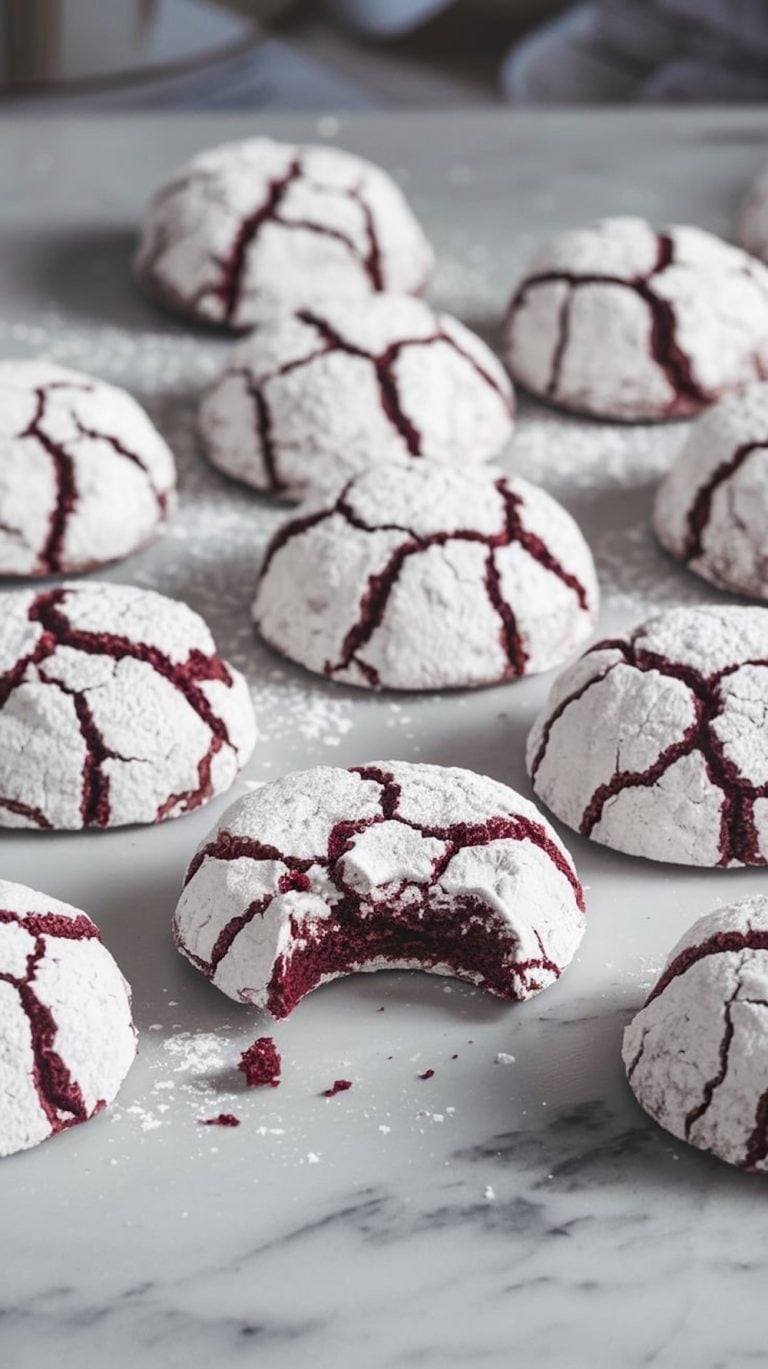
Roll each ball generously, until no brown shows. In the oven, the dry sugar shell sets first. Then the baking soda and molasses push the soft center up and outward, and the shell splits into those deep brown cracks. A thin coat gives faint, shallow lines. A thick coat on cold dough gives the bold white and brown pattern.
Powdered sugar sometimes soaks into a sticky dough ball within a minute and turns damp. If the coat looks wet before the tray goes in, roll the ball a second time. The second layer stays dry and bakes up white.
Pulling the Crinkles at 10 to 12 Minutes
Space the balls 2 inches apart. They are ready when the edges are set, the cracks are wide, and the centers still look puffed and a little underdone. They sink slightly and finish cooking on the hot pan. Leave them on the sheet for 5 minutes, then move them to a wire rack to cool completely.

Gray Tops, Flat Cookies, or Shallow Cracks
- Tops turned gray or patchy: the sugar dissolved into warm or sticky dough. Chill the dough longer and double roll.
- Cookies spread flat: the dough was not cold enough, or the baking sheet was still hot from the last batch. Let the pans cool between trays.
- Cracks are shallow: too little powdered sugar, or the dough sat out and warmed up before baking.
- Dry, crunchy cookies: they baked too long. Pull them while the middles look soft. At 12 minutes they are done even if they look underbaked.
- Spice tastes weak: the ground ginger was old. Fresh ginger makes the biggest difference of the four spices.
Gingerbread Crinkles vs Molasses Crinkle Cookies
People search for these as ginger crinkle cookies or spiced crinkle cookies, and they are close cousins of my molasses crinkle cookies. The difference is in the spice and the coat. These gingerbread crinkles use 2 teaspoons of ginger plus cloves and nutmeg and a powdered sugar coat, so they look snowy and taste like gingerbread. The molasses crinkles use less spice, more baking soda, and granulated sugar for a sparkly, crackly top.
Reader Batches of Gingerbread Crinkles
Readers have sent photos of their batches, and Erin left a note that sums up the method: “Followed the recipe exactly, chilled for 2 hours, used parchment paper.” Julie made them for three large families. Here are a few of the trays.
Fgustus: A Christmas Cookie Gift Box

Packed with cherry thumbprints and frosted sugar cookies. The crinkles hold up well in a gift box because the sugar coat does not smear like icing.
Heather: A Full Cooling Rack

Even rows on a wire rack, with the powdered sugar still bright white after cooling.
Wendy: Straight From the Oven

Fresh off the tray. You can see the sugar melting into the cracks, which is what a thin second coat helps prevent.
Erin: Eight on Parchment

Round, evenly spaced cookies with soft centers and fine cracks, baked on parchment after a 2 hour chill.
Making Gingerbread Crinkle Dough Ahead for Cookie Exchanges

The dough keeps covered in the fridge overnight, so you can mix it one evening and bake the next day. For longer, scoop the dough into balls without the sugar coat and freeze them in a bag. Let them sit at room temperature for about 15 minutes, roll them in powdered sugar, and bake. Coating them before freezing does not work well, because the sugar absorbs moisture and disappears.
Baked cookies keep for 5 days in an airtight container at room temperature. To freeze them, lay them in a single layer on a sheet until firm, then bag them for up to 3 months. Thaw at room temperature. If the tops look dull after thawing, a light dusting of powdered sugar brings them back.

They go well with a mug of gingerbread latte, hot chocolate, or spiced cider, and crumbled over vanilla ice cream they make a quick holiday dessert.
Pin These Gingerbread Crinkles for Your Christmas Cookie Tray

Save this recipe to your Christmas cookie board so it is there when baking week comes. For a tray with some contrast, bake a batch of dark chocolate crinkle cookies and bright red velvet crinkle cookies next to these. If you want more gingerbread, try gingerbread man cookies, gingerbread truffles, or gingerbread fudge, and browse the full list of 50 Christmas cookies for the rest of the tin.
Gingerbread Crinkle Cookies Recipe

These gingerbread crinkle cookies are soft, chewy molasses cookies made with brown sugar, ground ginger, cinnamon, cloves, and nutmeg, rolled in powdered sugar before baking. The recipe makes 24 cookies; the dough chills for 2 hours, then each tray bakes for 10 to 12 minutes at 350°F. A thick powdered sugar coat on cold dough sets first in the oven, so the spiced centers rise and crack it into deep white and brown crinkles. Bake them for a Christmas cookie tray, a cookie exchange, holiday gift boxes, or with hot chocolate. The dough keeps overnight in the fridge, the cookies stay soft for 5 days in a tin, and they freeze for 3 months.
Ingredients
- 2 ¼ cups (270g) all-purpose flour
- 2 teaspoons ground ginger
- 1 teaspoon ground cinnamon
- ½ teaspoon ground cloves
- ½ teaspoon ground nutmeg
- 1 teaspoon baking soda
- ¼ teaspoon salt
- ¾ cup (170g) unsalted butter, softened
- 1 cup (200g) brown sugar, packed
- 1 large egg
- ¼ cup (60ml) molasses
- 2 teaspoons vanilla extract
- ½ cup (60g) powdered sugar, for coating
Instructions
- PREPARE THE DOUGH: In a medium bowl, whisk together the flour, ground ginger, cinnamon, cloves, nutmeg, baking soda, and salt until fully combined. For best results, use a mixing bowl set. In a separate large bowl, use a hand mixer or stand mixer to beat the softened butter and brown sugar on medium speed until light and fluffy, about 2 to 3 minutes. Add the egg, molasses, and vanilla extract, then beat again until the mixture is fully incorporated. Gradually mix the dry ingredients into the wet ingredients just until combined. A digital kitchen scale provides accurate measurements for consistent cookies. Cover the dough tightly with plastic wrap and refrigerate for at least 2 hours or overnight. Chilling is essential for forming deep cracks during baking.
- SHAPE AND ROLL: Preheat your oven to 350°F (180°C). Line two baking sheets with parchment paper or a silicone baking mat for easy cleanup. Scoop tablespoon-sized portions of dough using cookie scoops, then roll each portion into a ball. The dough will be sticky, so working quickly is helpful. Roll each dough ball generously in powdered sugar until fully coated. A heavy coating enhances the crinkle effect during baking.
- BAKE TO PERFECTION: Place the powdered sugar-coated dough balls about 2 inches apart on a sturdy baking sheet. Bake for 10 to 12 minutes, or until the cookies have spread and the tops have formed deep cracks. The edges should be firm while the centers remain soft. Let the cookies cool on the baking sheet for 5 minutes before transferring to a wire cooling rack to cool completely.
Notes
Chill the dough for at least 2 hours; it is soft and sticky, and cold dough spreads less and cracks deeper. Scoop straight from the fridge and keep the rest of the dough chilled between trays. Coat each ball thickly in powdered sugar, and roll it a second time if the first coat turns damp. Pull the cookies when the centers still look puffed and slightly underdone, then cool 5 minutes on the sheet. To make ahead, freeze scooped dough balls uncoated and roll them in powdered sugar just before baking. Store baked cookies in an airtight container at room temperature for up to 5 days or freeze for 3 months.
Recommended Products
As an Amazon Associate and member of other affiliate programs, I earn from qualifying purchases.

Nutrition Information
Yield
24Serving Size
1Amount Per Serving Calories 147Total Fat 6gSaturated Fat 4gUnsaturated Fat 2gCholesterol 23mgSodium 82mgCarbohydrates 22gFiber 0gSugar 12gProtein 2g

Hi Emma! I just made your crinkle gingerbread cookies! They are delicious but mine flattened out! Does that mean I need to let them chill for longer? Thank you!
Hi Kendall! I’m so glad you enjoyed the cookies, even if they flattened a bit. Chilling the dough longer can definitely help, as it keeps the butter from melting too quickly in the oven. I’d also check your baking sheet—if it’s too thin, it can cause cookies to spread more.
And also – make sure your butter isn’t overly softened (it should be soft but not greasy). Let me know if you give these tips a try. Thanks for baking them and sharing your experience! 😊
Hey, I was wondering if this recipe could be made with margarine?
Hi Jaidyn,
Yes, you can absolutely make this recipe with margarine instead of butter! Just make sure to use stick margarine (not the spreadable kind) for the best results, as it has a similar fat content to butter. The cookies may spread slightly more, so chilling the dough for the full time is especially important. Let me know how they turn out if you give it a try! 😊
Delicious and well-loved by my family! They turned out nothing like the picture even though I chilled the dough extra long after reading some comments, and still flattened out, but they tasted and looked great nonetheless!
Hi Tara,
Thank you for trying the Gingerbread Crinkle Cookies! So great that your family loved the flavor—that’s always the most important part. 😊 If they flattened out, it could be the dough warming up too much during shaping. Next time, try popping the shaped dough balls back in the fridge for 10-15 minutes before baking. I’m so glad they still looked and tasted great. Thanks for sharing your experience!
So good . I refrigerated my balls for 10 min before baking each batch . They were perfect !
Glad they turned out perfect, Timothy! Chilling the dough for a bit before baking is a great trick. It helps them hold their shape beautifully. Thanks for sharing your tip!
Hi Emma. I’m interested in making these but want to know if they freeze well and if there are any special instructions to do so?
Thank you!
Hi! These gingerbread crinkle cookies actually freeze quite well. I’ve frozen them both baked and unbaked, and both methods work depending on what’s more convenient for you.
If you’re freezing the baked cookies, let them cool completly, then place them in a single layer on a baking sheet to freeze first. Once they’re firm, transfer them to an airtight container or freezer bag with parchment between the layers. They’ll keep their texture nicely for up to 2 months. When you’re ready to enjoy them, just let them thaw at room temperature.
If you’d rather freeze the dough, roll it into balls (before coating in sugar), then freeze on a tray until solid. Once frozen, store them in a container or bag. When baking, let the dough sit out for about 15 minutes, roll in the sugar, then bake as usual. You might need to add a minute or two to the baking time.
Let me know how they turn out if you give it a try 🙂